Influencer marketing in India has moved from an experiment to a core line in the marketing plan. This guide explains how it works in 2026, what it costs, which creators to choose and how to plan a campaign that you can actually measure.
Key takeaways
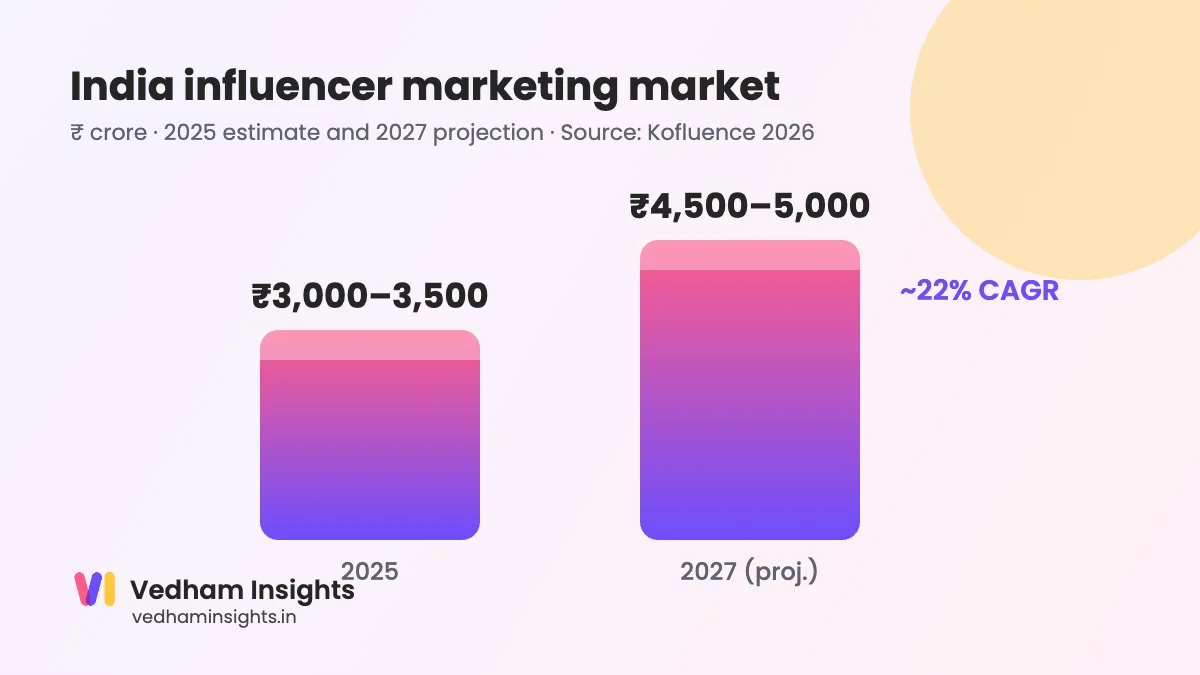
- India’s influencer marketing market was estimated at ₹3,000–3,500 crore in 2025 and is projected to reach ₹4,500–5,000 crore by 2027 (Kofluence, 2026).
- Instagram remains the first choice for most brands, with YouTube leading for long-form reviews and explainers.
- Nano and micro creators make up most of the creator base and often deliver stronger engagement in Tier II and III cities.
- The brands that win treat creators as a performance channel: clear objectives, tracked links and codes, and a test-and-learn budget.
What is influencer marketing?
Influencer marketing is a partnership between a brand and a content creator who has the trust of a specific audience. Instead of speaking through an ad, the brand speaks through a person that audience already follows. Done well, the content feels useful and native to the platform. Done badly, it looks like a paid post that nobody believes.
For brands, the value comes from three places: reach into communities that ignore traditional ads, trust borrowed from a creator’s credibility, and content that can be reused across ads, product pages and social channels.
How big is influencer marketing in India?
According to Kofluence’s 2026 Influencer Marketing Report, India’s influencer marketing market stood at ₹3,000–3,500 crore in 2025 and is expected to reach ₹4,500–5,000 crore by 2027, growing at around 22% a year. The same report counts 4–4.4 million active creators in India, with e-commerce (23%) and FMCG (19%) leading brand spend.
EY India’s influencer marketing study points in the same direction, projecting the market at ₹3,375 crore by 2026 and noting that 77% of brands trust agencies to manage influencer campaigns.
Types of influencers and when to use each
Follower count is only a starting point, but the tiers are a useful way to plan budget and reach.
| Tier | Followers | Best for |
|---|---|---|
| Nano | 1K–10K | Local and niche communities, product seeding, high volumes of authentic UGC |
| Micro | 10K–100K | Engaged niche audiences, consideration and conversions at an efficient cost |
| Mid-tier | 100K–500K | Balancing reach and relevance for launches and category campaigns |
| Macro | 500K–2M | Broad awareness and cultural moments |
| Mega / celebrity | 2M+ | Mass reach and brand fame, usually with the highest cost per result |
Kofluence reports that 61.1% of Indian creators are nano-tier, and that engagement in Tier II–IV cities (4.5–5.5%) tends to be higher than in metros (3–4%). For many brands, a portfolio of nano and micro creators outperforms a single large name on cost per engaged viewer. We cover this trade-off in detail in our guide to influencer marketing costs in India.
Which platforms matter in India?
- Instagram is the default for most categories, especially beauty, fashion, food, travel and D2C. Reels drive discovery; Stories drive clicks.
- YouTube leads for long-form reviews, tutorials and high-consideration purchases like tech, finance and education. Well-optimised videos keep earning views for months, which is why YouTube SEO matters.
- Regional and vernacular creators are growing fast. Kofluence found 62% of creators reporting more regional-language work, a strong signal for brands targeting Bharat beyond the metros.
How to plan an influencer marketing campaign
1. Start with the consumer, not the creator
Before shortlisting anyone, be clear on who you want to reach, what they watch and what would change their mind. Audience research and trend analysis make every later decision easier.
2. Set one primary objective
Awareness, consideration and sales need different creators, formats and KPIs. Pick one primary goal and define how you will measure it before the brief goes out.
3. Choose creators on audience fit, not follower count
Check audience location, age and gender split, engagement quality, comment sentiment and past brand work. A smaller creator whose audience matches your customer beats a larger one whose audience does not.
4. Write a brief that gives creative freedom
Share the product truth, the must-say messages and the don’ts, then let the creator tell it their way. Strong hooks in the first two seconds decide whether a Reel is watched or skipped.
5. Negotiate clearly
Agree deliverables, timelines, usage rights, exclusivity and payment terms in writing. Usage rights and whitelisting (running creator content as ads) can significantly change the price.
6. Track, optimise and report
Use unique links, UTM parameters and discount codes so you can connect content to results. Read performance while the campaign is live and move budget to what works. Our guide on measuring influencer marketing ROI covers the metrics in detail.
Rules brands must follow in India
The Advertising Standards Council of India (ASCI) requires paid or incentivised content to be clearly labelled, for example with #ad, #collab or #sponsored, placed where the audience will see it. In April 2025 ASCI added stricter rules for finance and health: investment-related influencers must be SEBI-registered and display their registration, and creators giving specific health advice need relevant qualifications (LexOrbis summary). Build these checks into your creator selection and approval process.
Common mistakes to avoid
- Choosing creators by follower count alone.
- Over-scripting content so it sounds like an ad.
- Running one-off posts instead of repeated partnerships that build familiarity.
- Not agreeing usage rights before content is made.
- Reporting only reach and likes, with no link to business outcomes.
Should you work with an influencer marketing agency?
You can run creator campaigns in-house, but it takes time: discovery, outreach, negotiation, briefing, approvals, compliance, tracking and reporting. An agency brings creator relationships, negotiation experience and measurement systems. If you are comparing options, use our checklist for choosing an influencer marketing agency.
At Vedham Insights we combine influencer marketing with consumer intelligence, so every creator choice is backed by audience research and every campaign is judged on results. Talk to us about your next campaign.
Frequently asked questions
Is influencer marketing effective in India?
Yes, when it is planned around a clear objective and the right audience. Market growth of around 22% a year (Kofluence) shows brands are seeing enough return to keep increasing budgets.
Which is better: micro or macro influencers?
Micro influencers usually deliver stronger engagement and better cost efficiency for niche products; macro influencers deliver scale. Many brands use both: macro for reach, micro for trust and conversions.
How much budget do I need to start?
You can start with a small test using nano and micro creators, then scale what works. See our influencer marketing cost guide for typical rates.