
Measuring return on investment is the most common challenge in influencer marketing. This guide shows how to set objectives, choose the right metrics, track results and calculate ROI, so you can tell which creators actually grew your business.
Key takeaways
- Decide what success looks like before the campaign starts, then pick KPIs that match the objective.
- Promo codes (used by 45.9% of brands) and affiliate links (26%) are the most common tracking methods (Influencer Marketing Hub, 2026).
- Report cost per result, such as cost per engaged view, click or sale, not just reach.
- Build a creator performance record so each campaign makes the next one smarter.
Why measuring influencer ROI is hard
People often see a creator’s post, remember the brand and buy days later through search or a marketplace. That makes attribution messy. EY India lists determining ROI as one of the biggest challenges marketers face with influencer campaigns (EY, 2024). The answer is not perfect attribution, but a consistent measurement system you trust.
Step 1: Match your KPIs to your objective
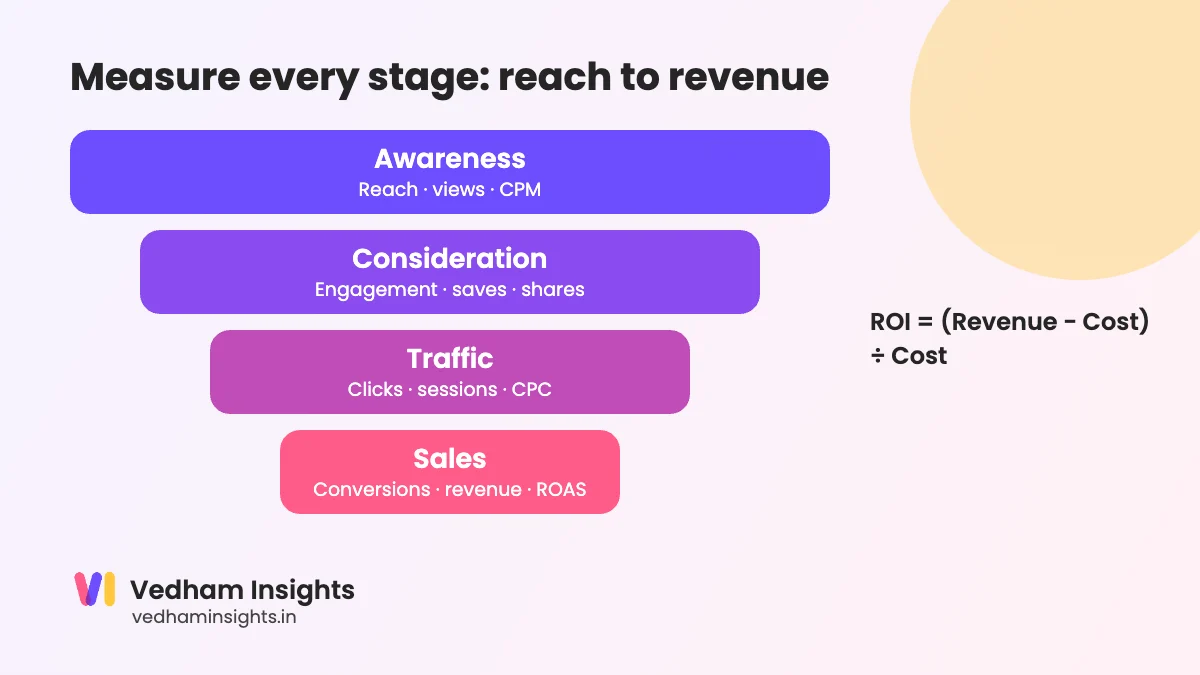
| Objective | Primary KPIs | Supporting metrics |
|---|---|---|
| Awareness | Reach, impressions, video views | Cost per thousand views, share of voice, branded search lift |
| Consideration | Engagement rate, saves, shares, profile visits | Comment sentiment, watch time, cost per engagement |
| Traffic | Clicks, landing page sessions | Cost per click, bounce rate, time on site |
| Sales | Conversions, revenue, promo code redemptions | Cost per acquisition, average order value, ROAS |
Influencer Marketing Hub’s 2026 Benchmark Report found brand awareness is still the most-selected KPI (55.1%) among brands growing their budgets. Awareness is valid, but it should be measured with the same discipline as sales.
Step 2: Set up tracking before content goes live
- Unique links with UTM parameters for each creator, so Google Analytics shows traffic and conversions by creator.
- Creator-specific discount codes to capture sales that do not come through a link, including marketplace orders.
- Affiliate links where you pay on performance.
- Platform insights from creators (reach, views, saves, audience demographics), shared as screenshots or through platform tools.
- Branded search and direct traffic trends during and after the campaign, to capture the halo effect.
Step 3: Calculate ROI
The basic formula is:
ROI (%) = (Revenue attributed − Total campaign cost) ÷ Total campaign cost × 100
Total campaign cost should include creator fees, product costs, agency fees, production and any paid amplification. For example, if a campaign cost ₹2,00,000 and tracked sales brought in ₹5,00,000, ROI is (5,00,000 − 2,00,000) ÷ 2,00,000 × 100 = 150%.
For awareness campaigns, compare cost per thousand engaged views against your paid social benchmarks. If creators deliver attention more cheaply than ads, that is a real return.
Step 4: Compare creators on cost per result
Rank every creator on the same metrics: cost per engaged view, cost per click and cost per sale. You will often find that a few mid-sized or micro creators deliver most of the results. Over time, this becomes a creator performance database that makes every future selection sharper.
Step 5: Optimise while the campaign is live
Do not wait for the final report. After the first wave of content, look at which hooks, formats and creators are working. Put paid support behind the best posts, brief the next creators on what worked, and pause what did not.
Benchmarks and expectations
The same Influencer Marketing Hub report found 65.9% of respondents expect payback within a month, including 48.4% within two weeks. That shows how many brands now treat creators as a performance channel. Your own benchmarks will depend on category, price point and purchase cycle, so compare each campaign with your previous ones, not just industry averages.
Common measurement mistakes
- Counting followers or likes as success.
- Forgetting to include all costs in the ROI calculation.
- Using one code or link for every creator, which hides who performed.
- Ignoring the halo effect on branded search and marketplace sales.
- Stopping measurement the day the campaign ends.
Make every rupee accountable
Campaign analytics and a creator performance database are core to how Vedham Insights works. We agree KPIs before the brief, set up tracking for every creator, optimise live and report what worked and what to do next. See our analytics services or talk to us.
New to creator campaigns? Start with our complete guide to influencer marketing in India, or check typical influencer rates in India.
Frequently asked questions
What is a good ROI for influencer marketing?
Any positive return is a start, but the right benchmark is your other channels. If creators deliver customers or attention more cheaply than paid ads, they are working.
How do I track influencer sales on marketplaces?
Creator-specific discount codes and marketplace attribution tools help, alongside tracking branded search and sales lift during the campaign.
Which metrics matter most?
The ones tied to your objective. For sales, cost per acquisition and revenue; for awareness, cost per engaged view and reach within your target audience.